[Note: mild spoilers for Jurassic World: Fallen Kingdom throughout, but the major ones will be tagged.]
Jurassic World: Fallen Kingdom has, at its core, two very different movies fighting for dominance. One is the modern mediocre action movie, with its clichéd, easy-to-predict one-liners and bland, slightly-stubbled leading man and elaborately choreographed yet snore-inducing hand-to-hand combat sequences. The other is a genuinely deep and compelling iteration on the series it carries on—a series that has rarely managed to capture any of the magic of Spielberg’s original masterpiece, but here comes the closest it ever has to understanding what made that first movie so good. But of course, in the end, Fallen Kingdom can only be one film. The side that wins out will determine whether it further wastes its series’ potential as another bland action flick, or whether it presents a reason to, despite its many flaws, keep digging away at this chunk of amber on the off chance that, someday, it might produce another indomitable gem.
And for me, a true believer in that first film and a skeptic on the rest, it was very happily the latter.
That’s not to say Fallen Kingdom is without its flaws; after all, I just laid out its core issue. Despite its best efforts, it just can’t quite seem to shake the tropes that drag down modern action blockbusters (at least those not called Kingsman or Fury Road). To illustrate that, consider a scene (*slight spoilers*) about two-thirds of the way through its (surprisingly manageable) 130 minute runtime, where Chris Pratt finds himself fighting an unnamed goon with that same nameless mixed martial art that all of today’s action films must be contractually obligated to include. This happens, of course, as what is likely the most dangerous animal to ever roam the Earth attempts to escape its cage and chow down on the (screaming) millionares that had come to auction it off.
I have nothing against Chris Pratt. I like most of his projects. But I think this movie gives him painfully little to work with, and that it’s barely worth writing his character’s name in this post because of how pointless it would be. And in that moment, I do not want the camera to focus on him separating, however skillfully, a goon from his pet cattle prod.
No. I want to see an angry fucking dinosaur eat those scared fucking rich people like it fucking well deserves.
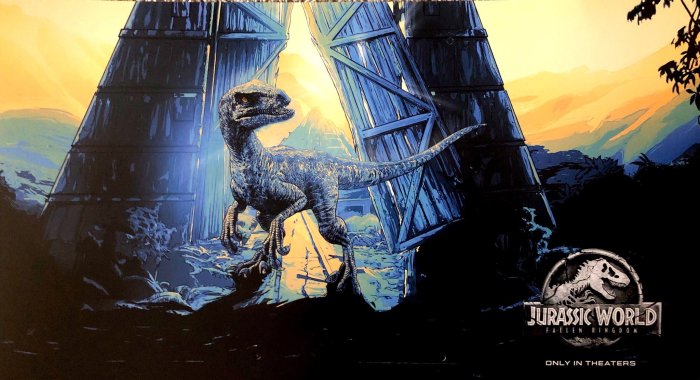
Jurassic Park understood this; of course, in 1993, it was just one slimy lawyer and not a crowd of millionares, but that film appreciated the visceral, cathartic joy of watching a horrific death come to someone who actively courts it. And, on the flipside, that movie also understood what Fallen Kingdom takes to heart in its final act—the real potential for those dinosaurs to turn on the characters that don’t deserve it, and the terror that comes with watching a scared, innocent child face down some of the most terrifying (at least in this imagining) creatures to ever inhabit the Earth.
And after all, that’s one of the main underlying aesthetics of the franchise, isn’t it? Each Jurassic Park film—the original, Lost World, III, Jurassic World, and Fallen Kingdom—centers its emotional weight, however successfully, around one or two child characters and their near-death experiences with dinosaurs. Some of these are brought to life more successfully than others; we probably shouldn’t talk about the gymnastics sequences in Lost World, and Jurassic World’s efforts on this front were so mediocre I can’t even remember those characters’ faces. But, on the flip-side, the velociraptor sequence late in in Jurassic Park constructs some of the tensest, most thrilling minutes ever put to film. Now, while Fallen Kingdom doesn’t equal that scene, it comes far closer at multiple points in its climax than any of its siblings (with a respectful nod to III’s birdcage) ever have.
Meanwhile, that brings me to another core tenet of this particular franchise: that, at their best, they’re not really typical action films: they’re horror movies of the kind that Steven Spielberg (and precious few others) understand how to make. And that’s to say that, when they try to be action movies (as Lost World and Jurassic World did, and as Fallen Kingdom does for much of its first act), they lose a defining element: an undercurrent of terror born both of the fearsomeness of their dinosaurs, and the accompanying horror from the hubris that led to their creation.
And to follow that logic back, Spielberg might be associated with the blockbuster; after all, he more or less created that category of film, but its worth remembering that his big smash, the film that launched his career into the stratosphere and created the mere concept of the summer blockbuster, was a horror movie. Sure, like Jurassic Park, you can call Jaws a thriller, but “thriller” is itself a misnomer, a genre that exists to comfortably categorize those action movies that drift uncomfortably close to the edge of horror. And Jurassic Park follows in its predecessor’s wake—it’s horror storytelling injected with the heart that comes from centering that horror’s emotional weight on child characters (something another noted horror storyteller, Stephen King, understands equally well.)

So there we have the two foundational pieces of a “good” Jurassic Park film—compelling child characters and their insertion into a very specific brand of horror. But beyond that, what exactly binds these films together (yes, besides dinosaurs)? Well, for most, a core debate about the ethics of playing god and bringing the dead back to life. Alongside that, a set of dubious scientists or researchers unable to comprehend the consequences of their work, and another set of entrepreneurs, traffickers, or military men looking to twist that work to their own gain. Jurassic World dallied in a bit of this, but those elements felt like plot dressing—a contrived excuse to re-introduce John Hammond’s dinosaurs to the world. Fallen Kingdom, however, takes that thread deeper with a simple twist: this time (*entering major spoiler territory—I’ll key you in when it ends*) its dinos aren’t the only genetically-engineered faces in its cast.
That late twist, that Maisie, Fallen Kingdom’s core child character, is in fact a clone of her “mother,” is the type of move that immediately elevates the film around it. In hindsight, in the world John Hammond built, it seems inevitable that his genetics technology would be used to clone or copy or, in this case, recreate someone who died all too young. As the young “granddaughter” of Benjamin Lockwood, Maisie spends the first two acts of Fallen Kingdom asking about her mother, who Lockwood tells her died in a car crash long before. But of course there’s more to that story, and when she learns the truth: that, grief-stricken over his daughter’s death, Lockwood used the same technology that Hammond used to recreate his dinosaurs to recreate his daughter, she becomes a kind of analogue that the series’ dinosaurs have never really had. Not only does this underpin the film’s climax: a moment where its characters are actually forced to grapple with the nature of the life they’ve played a part in creating, but it marks another thematic shift in the series.
Namely, Fallen Kingdom is the first film in the series where its dinosaurs actually feel like characters. The scene that embodies this most is also the transition between its mediocre action half and its full Jurassic Park half (ironically, the half that happens outside Jurassic Park itself), when a bracchiosaurus watches a ship depart its dying island and, in a cloud of lava and smoke, goes extinct before the characters’ eyes. It was a shocking moment in that it showcased a kind of empathy for the series’ dinosaurs that the previous films had rarely, if ever, included. And it foreshadowed the film’s ultimate point—that once it uh, finds a way, whether lab-created or all-natural (whatever the hell that means), life is life. (*end spoilers*)

And in short, that’s what Fallen Kingdom itself brings to the table; around that, it builds something like the Captain Planet of Jurassic Park films—sequences and scenes and plot elements and tropes plucked from every other (and yes, I do mean every other) film in the franchise. There’s Lost World’s blood transfusion on the open ocean; there’s III’s love of pteranodon attacks (and not to mention its exact same ending shot). There’s a series of scenes where a crucial system shuts down and an engineer or analyst (then Samuel L. Jackson’s John Arnold, now Justice Smith’s Franklin Webb) must reboot it. There’s a badass woman scientist who won’t take your sexist bullshit (first Laura Dern’s Ellie Sattler, now Daniela Pineda’s Zia Rodriguez). Of course, Fallen Kingdom’s Ken Wheatley is effectively the antithesis of Jurassic Park’s iconic Robert Muldoon, but twisted reflections still count as a callback. And there are two sequences—one at the opening and one during the island escape—that effectively rip multiple scenes, bit-for-bit, from the end of Jurassic World (which itself took one of them straight from Jurassic Park itself).
But that sounds like a mess, and somehow, Fallen Kingdom is the farthest thing from a mess. While its immediate predecessor felt like a pure nostalgia trip, leveraging the ideas and iconography of Jurassic Park (and only Jurassic Park) without building anything of its own on top of them, Fallen Kingdom cherrypicks the strongest elements from its predecessors’ storylines and weaves them into a film that, once it drops its iniial disaster movie facade for the proto-Gothic expanse of Lockwood’s estate, feels iterative rather than derivative. Part of that comes from its final acts, which take place in that quasi-Gothic mansion far from any setting the series has ever seen. Part of that comes from the elements I mentioned before—Maisie’s character arc and the weight it lends to dinosaurs that have always, in a weird way, felt more like props than creatures. And a whole lot of it comes from a blending of horror and heart that Spielberg would be proud of, and a film that knows how to balance both to leave its audience trembling with tension. Much more than Lost World and Jurassic World, and even a bit more than the (oft-maligned, but in my opinion underrated III), Fallen Kingdom leans into its horror roots and delivers a couple of truly spellbinding sequences, mixed with a fantastic second setting and a surprisingly compelling late plot development about trafficking and war profiteers and the potential for unchecked technological growth to create many more problems than it solves. Its inability to escape its action tropes (and the need to have the series’ iconic T-Rex in almost every shot), particularly in its first forty-five minutes or so, does stop it from ascending to the heights of Spielberg’s original. But its subsequent fusion of the series’ strongest elements and its surprisingly deep commitment to its franchise’s core aesthetic—that combination of childhood and horror that characterizes the best work of both Steven Spielberg and Stephen King—elevates it far above the previous efforts to engineer a worthy Jurassic Park sequel. Far more so than the three that came before, Fallen Kingdom deserves to be called a Jurassic Park movie.
. . .
And hey, if that’s not enough for you, I’ll also promise that at least one person who really does deserve it will, before movie’s end, get their face chewed off by a very hungry, very angry dinosaur.
[All images are from Dairy Queen’s promo campaign for Fallen Kingdom.]

 Sunset Over Ithaca