A few hours after beginning for the first time, I put my controller down, sighed, and turned to something else. I’d given an attempt, a couple, actually, to play something that had been advertised as one of the most important games ever made. But after a couple of hours it just hadn’t grabbed me; the world design felt too obtuse, the difficulty based more on confusion than skill and pattern recognition. The environment felt like a giant puzzle—but missing its most important pieces. I resolved to try again in a bit, but for now, all I had was the creeping disappointment that the work before me was showing its age.
Then, a few months later, I decided that it deserved one more try. That time, something clicked; those pieces of the game’s puzzle-box world finally slipped into place. A few weeks later, I defeated the final boss and watched the credits roll, overcome with feeling at the adventure that had played out before my eyes.
This was my experience over the past few weeks, playing through Dark Souls for the first time. It was also my experience several years ago, when I first played The Legend of Zelda: Ocarina of Time. Both times, I ended my first attempts because their twin worlds felt too obtuse—Dark Souls perhaps by design, Ocarina of Time more due to its age and resulting design philosophy. They don’t make games like they used to, and in a lot of ways that’s a good thing. Old games sometimes feel designed to be used with a wiki (and when you consider the manuscript-sized manuals many were shipped with, some actually were); as a result, their worlds are not prone to intuitive navigation. Dark Souls, in that sense, feels like an intentional relic: a game that, in avoiding signposting its points of progress, calls back to the days of manuals and frequent GameFAQs searches. Of course, rather than shipping with a manual, it depends on other players to build its guides.

But the bond between Dark Souls and Ocarina of Time runs far deeper than their initial obtuseness—to a point where the first Soulborne game feels like a crystallization of the first 3D Zelda’s design ethos. Both present the player with complex, interlocking worlds; spaces that revel in a secret, paradoxical linearity that curves and bends and doubles back on itself, that focuses on shortcuts and secret paths to optimize the player’s path forward. In Ocarina, those are its dungeons; in Dark Souls, that’s the design philosophy behind the entire world. And at that realization—that I wasn’t only moving forward, but opening up new paths for the next run—the entire game seemed to reveal itself.
I still remember the moment I really fell in love with Ocarina of Time. It came a ways in, after the jump forward in time and the race for the Hookshot, when I found the Forest Temple nestled in its corner of the Lost Woods. I still think about that space—that ancient, mysterious mansion, more like some colonial lord’s decrepit manor than the game’s typical caves and castles. It loops and reverses on itself, building secret verticality into its spaces, its doors and gateways opening up shortcuts and new areas with each journey through. Later dungeons only built on that philosophy—the Spirit Temple in particular, with a colossal facade and central chamber as its apex. At least, until Dark Souls.

Because Dark Souls mirrors Ocarina of Time not only in design, but in its sense of scale, and in the way its environments emphasize the main character’s smallness in the grand scheme of its vision. Both games place their protagonists in vast worlds and soaring spaces. They present places that had once served other purposes: ones apparent in their architecture or decoration or the enemies that still prowl their halls. The Forest Temple was once a mansion; the Shadow Temple once a prison, both for beings seemingly three times as large as Link’s adult or child forms. Anor Londo, meanwhile, seems a city for giants, with buttresses wide enough to walk on and hallways built for beings that stand thirty feet tall. The bookshelves in The Duke’s Archives stretch far higher than human hands could reach; the underground warren of the Tomb of the Giants seems hewn by little more than erosion and time. In both games, these spaces function like the bodies of some vast, primordial being—not as much created as emerged from a once greater world. And once inside, their few remaining inhabitants act as an immune system targeting an invader. You.
There, in terms of its combat, Dark Souls also clearly descends from the Zelda tree—building its complex and varied fighting system out of the core pieces pioneered in Ocarina of Time. Z-targeting, which Zelda popularized (if not invented), sees liberal use throughout the world of Lordran, as does the basic sword-and-shield formula that Ocarina of Time’s initiated.

Of course, Dark Souls heavily complicates that originally simple system, introducing parrying and riposting, RPG-esque leveling, magic, and a multitude of different weapons and items. In a sense, it complicates every element that Ocarina of Time introduced to games as a storytelling medium: its approach to world-building and its spaces that feel archaic, almost rediscovered, plays like a matured version of a rawer classic. This is clear throughout its world—through its many switchbacks and shortcuts and secret pathways, all meant to clarify and optimize the paths its players can take through its many hazards. And it’s most apparent in what is perhaps the game’s crown jewel: the Painted World of Ariamis, a level that strips away the Metroid-esque non-linearity that characterizes the rest of the game and instead builds a tight, focused level in the exact mold of a 3D Zelda dungeon. Here, there is a path forward—a progression of doors to unlock, enemies to best, keys to find, and switches to be flipped. There are a couple of small detours, little optional items hidden off the beaten path, but in essence the level revolves around opening a path from bonfire to its eventual boss.
Those bosses, moreover, represent another common point between Soulsborne and Zelda (and, as a third point, Metroid). In both series, dungeon bosses comprise the final challenge of a given area—a test of mastery in both combat and, in some senses, puzzle-solving. That puzzle can be as simple as where or when to strike: how to dodge Bongo-Bongo’s drumbeat hits or thread the minuscule windows that separate Ornstein and Smough. But in almost all cases, bosses never just act as a damage sponge; they’re an integral part of that area or dungeon, and sometimes even an indication of what caused that place to go so wrong.
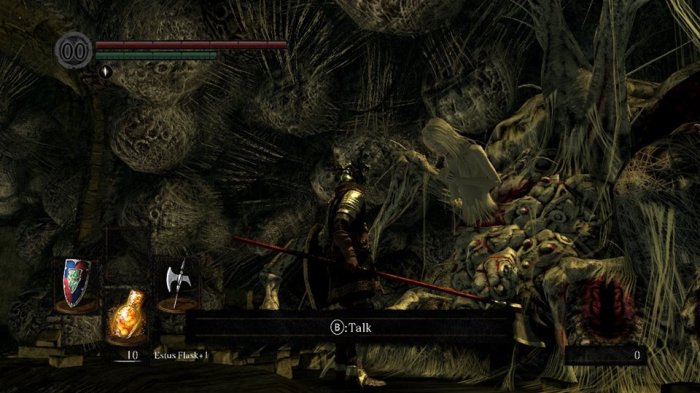
With that in mind however, there is one lesson Dark Souls largely refused to take from Zelda—and in particular from Ocarina’s direct successor, Majora’s Mask. Both are gloomy, murky experiences that take place in decrepit, dying worlds. Both feature characters doomed to failure, death, or worse. But Majora understands the potential of small moments of levity: of a brush with light, or joy, or witnessed love, made all the more compelling by the surrounding darkness. Dark Souls has little time for that—and I think that’s intentional, even if, it made the game a less compelling experience. The moments that still stand out, that did in the end feel like they mattered, were tethered to such contrast; Solaire’s insanity and Siegmeyer’s death are only gut-wrenching because they provide Lordran with its rare bright moments. The story of Sif and Artorias operates on a similar wavelength; the revelations that come in Oolacile about their origins and relationship elevate the Great Grey Wolf’s final fight to an actual narrative sequence rather than a setpiece.

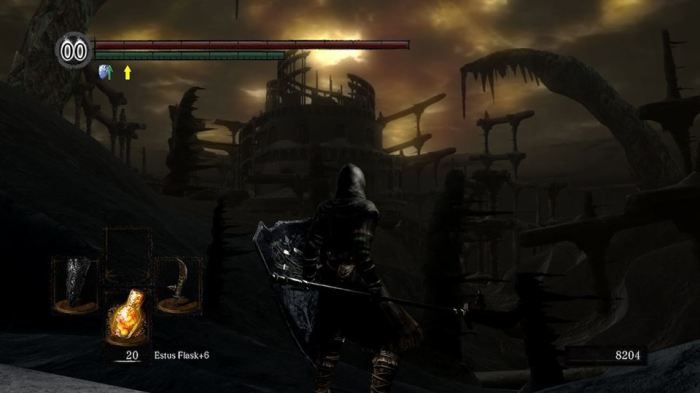
But Dark Souls never really explores what could have been if it added any contrast to its world. Instead, it doubles down on the decay and decrepitude, to the point where, by the end, it all becomes monotonous. Though it builds a stunning final area in the Kiln of the First Flame and a satisfying final boss in Gwyn, I still felt like I was reaching for something—waiting for it to give its dark, miasmatic atmosphere a moment to breathe. Perhaps this is also a hazard of having played Hollow Knight—a game that does understand the power of that kind of contrast, and that for it is, in the end, a better game.
But still, after those credits played, I found myself continuing—striding back towards the Asylum Demon at the start of New Game+ with halberd in hand, smiling. Because now, I was the powerful one, and the world of Lordran was about to get exactly what it deserved. In the end, just like Ocarina of Time, no matter how grim it tries to be, Dark Souls can never escape its own power fantasy. Ultimately, that becomes its substitute for joy.

 Sunset Over Ithaca
One thought on “Six Years before Breath of the Wild, Dark Souls Reinvented The Legend of Zelda”