[This post is the first entry in my Twelve Months, Twelve Games essay series, and contains spoilers for Disco Elysium and S1:E4 of Person of Interest.]
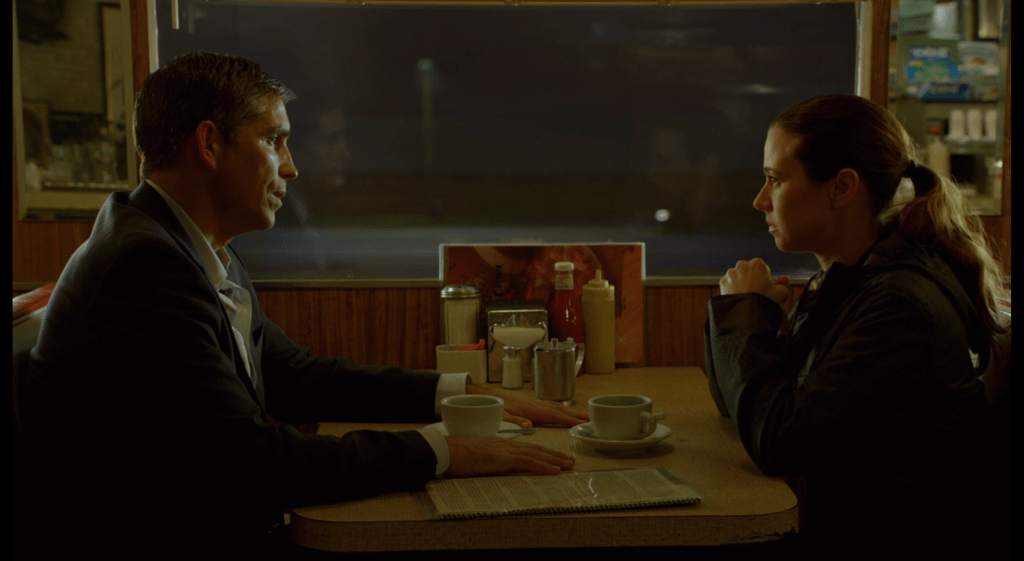
Of all the strange detritus one picks up over years of consuming media, little has stuck to me as tightly as the fourth episode of Person of Interest — Jonathan Nolan’s crime procedural-turned-science-fiction thriller than ran on CBS in the mid-2010s. First airing on October 13th, 2011, “Cura te Ipsum” tasked the show’s protagonists, a pair of vigilantes, Mr. Reese and Mr. Finch, with access to an omnipresent surveillance network called only The Machine, with trailing a young physician named Megan Tillman. When they’re given her identity, they know that she will soon either be the victim, or the perpetrator, of a violent and likely fatal crime — and, at this early point in the show’s runtime, the question of which she’d end up being became the episode’s core twist.
Over the course of its 103 episode run, Person of Interest would spiral from a relatively realistic crime thriller into something almost cyberpunk, and with that evolution it would dive fully into themes surrounding total government surveillance, technological advancement, and AI. It was also, we learned halfway through its run, a show much closer to reality than even its creators knew. But its core concerns, the things that drove it as a work of art, were always less about the machinations of science-fiction and science-fact, and more about the ways its characters sough redemption for their past mistakes. That thread began with Tillman — a doctor, dedicated to saving lives, who they eventually discovered in the midst of planning a murder. Her would-be victim was a man who had drugged and raped her sister, and who’d gotten off scot-free when she took her own life with an overdose a year later. The episode climaxes with a heart-to-heart between the physician and Reese, a former government spook who we know has killed countless people — and who, we later learn, had found himself before in Tillman’s shoes.
“I know that you’ve spent years of your life healing people. And I know that, if you do this, if you murder this man in cold blood, it will kill you.”
“You get a second chance. You get to let go. You get your life back. [And your sister] gets to keep her memory of you.”
Person of Interest S1:E4
The title of the episode comes from a Latin proverb, one attributed by Jesus in the Bible and thus likely even older. It translates to: physician, cure thyself — implying that a doctor cannot hope to successfully heal their patients if they themselves are hurting. And in the almost twelve years since I watched this episode, I’ve thought about it often. Both as our healthcare systems shuddered under the weight of a pandemic, and more broadly, as a rule of sorts for living. Don’t expect to fix others if you yourself need fixing.
***
On October 15th, 2019, just two days off the eight-year anniversary of the episode’s first airing. Estonian game development collective ZA/UM released Disco Elysium, a role-playing game as deeply mired in themes of grief and planetary mourning as it is the dense political debris of revolution. As in many episodes of Person of Interest, Disco Elysium uses a crime — the apparent lynching of a corporate mercenary by a striking labor union — as a gateway to explore a broader set of structures. The distrinct of Martinaise, in the vast city of Revachol, sits at the epicenter of a failed communist revolution: one defeated by a neolibral coalition of nation-states who’ve since squeezed the the city into serving global capitaism. Alongside its dense tapestry of political factions and points-of-interest, it also provides a resonant space for the game’s main character: an amnesiac detective sent out to solve the murder, who finds himself reconstructing his own sense of self along the way.
That journey, which over the game’s 30-some odd hours balloons in what seems to be vast conspiracy before shrinking back into a dispirited and melancholy truth, takes Harry and his momentary partner, Kim, through every reach of Martinaise, where they fill in his blank memory with all its history. He learns about the revolution, and the fractured dregs of communism that remain; he interacts with racists and fascists, as well as agents of the neoliberal order, all together providing a kind of tapestry of ideology and motion.
As a game (and larger world) built from the ground up an Estonian development team, Disco Elysium should be understood in context with that history. Here, in the United States, the idea of a working class revolution — even a social democratic state — is just that: an idea, unrealized and unpracticed, and free of a kind of history in the way, elsewhere in the world, it isn’t. I’ve heard the game’s approach to leftism referred to as defeatest, or myopic: that it ends without providing an image of what progress may even mean. And from an American lens, it perhaps does: it seems to grow mired in its own melancholy until its end, when Harry and Kim learn that their web of vast conspiracies was little more than a wanton act of destruction by a lonely, insane man. But that reading loses something of the game’s own cultural context, by, ironically, ignoring how it ties back to the place that actually produced it.
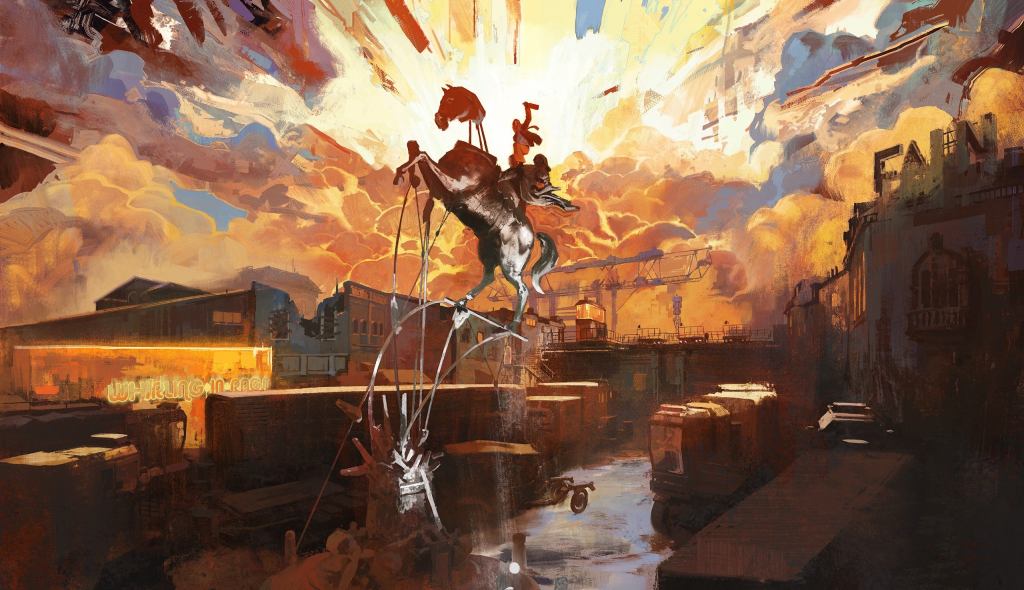
I do not know what it’s like to live, especially as someone on the political left, in the localized and historical shadow of the world’s largest failed communist project. I can only catch glimpses in the rare moments that art like this one, from former Soviet states, makes its way into the zeitgeist. But even in that lack of experience, Disco Elysium seems to drip with that particular postwar malaise — its characters cannot themselves point a new direction forward, because everywhere they point brings them back to where they were before. To most of them, a brighter future seems impossible in a way it never can to me, because unlike them, I’ve never seen it fail so close to home. As the leader of the game’s communist reading group says at the end of his quest:
Communism doesn’t dangle any promises of eternal bliss or reward. The only promise it offers is that the future can be better than the past, if we’re willing to work and fight and die for it.
I guess you could say we believe it because it’s impossible.
It’s our way of saying we refuse to accept that the world has to remain like this.
At its core, Disco Elysium is a game about the “post-” in words like postcolonial, postrevolutionary, posthistorical, postmodern; it is about living in the nebulous after, in the shadow of a happening much larger than whatever small piece of the world we can identify ourselves. And so, its version of a new way forward becomes almost unrecogniable — like an undiscovered creature blending with the reeds.
Despite its air of melancholy, there are a few moments in the game that generate pure wonder: most notably a series of sidequests in the district’s broken-down church. These revolve around a set of threads that twist through every piece of Martinaise: through the entropy slowly dragging the fabric of its world apart, and the ways in which its people still attempt to hold it all together. More concretely, they center on a group of young people trying to start a night club with their own nascent genre of music — and, followed to the end, they culminate in a dance party so ethereal and groovy that Harry leaves his earthly shell behind and briefly, has an audience with the spirit of Revachol itself.
That’s the first piece of Disco Elysium‘s core thesis: one that, on the surface, seems to just be a rough sketch of finding time to feed one’s wounded soul. But look a layer deeper, and there’s more; the sequence in the church brings about a kind of openness that’s missing from much of Martinaise — an openness to wonder when it seems all else has tried and failed, and a willingness to believe in something without the cynicism that a postwar fog brings to settle on the world.
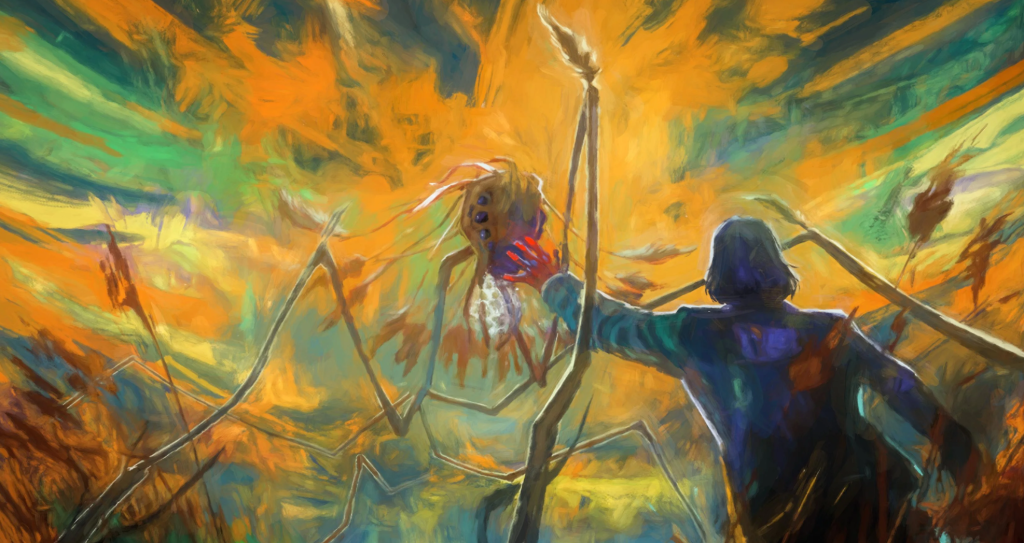
This thesis emerges further in the game’s core text only at the very end, when the murderer’s confession on a deserted islet in the city’s frigid bay is interrupted by the appearance of a cryptid. Depending on a player’s path through the game, they’re likely to encounter a small band of crypozoologists in search of the Insulindian Phasmid: a kind of undiscovered stickbug believed endemic to this small corner of the world. That quest, up until this final moment, seems to end in failure — the scientists losing faith in their convictions as their traps fail to bring in any new discoveries. But with the appearance of the creature in the story’s final moments — a sequence filled with strange and awestruck wonder — the game finally does chart a kind of future. The phasmid greets Harry and Kim with something that does not fit into their narrow conceptions of the world, that demands they open themselves up to new horizons. It posits that, when every avenue toward progress seems to already have been tried and failed, new ones may reveal themselves at any time. Disco Elysium does not believe in nothing, and it certainly does not believe that we cannot find new ways to save ourselves. More than that: it wants us to, but it knows that, first, it has to peel away the rubble, wave away the smoke, and shout into the ruins that still, another world is possible. It may just take a recalibration of perspective to see it.
***
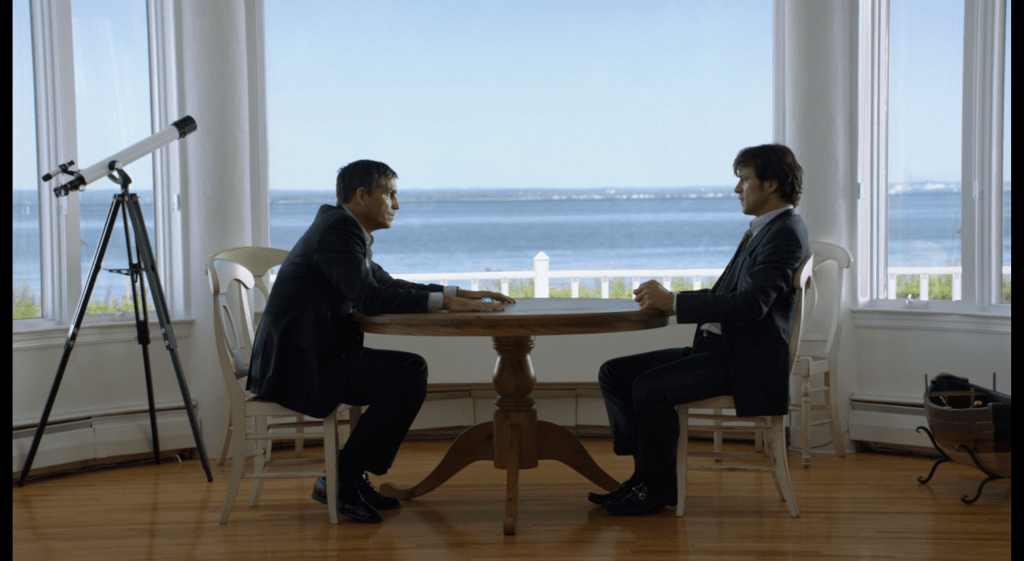
After talking Megan Tillman into handing him the keys to her van, Reese drives the rapist she had kidnapped to an empty mansion on the coast. Once there, he sets the man on a chair next to some bay windows by the ocean, and waits across the table for him to reawaken. In a twisted reflection of the previous scene with Tillman, Reese now leans across the table: menacing, aggressive, the coffee cups replaced with a shiny silver gun. The episode concludes with the following conversation — Reese, morose and brooding, a murderer many times over, deciding whether to kill the rapist himself, while the man blubbers helpless protests from the other side. It ends without a resolution; the picture cuts to black, leaving Reese’s choice to a viewer’s interpretation (though, for what its worth, the man is never seen again). Those two men framed by ocean waves have lingered like an afterimage on my brain since then. If I try, I can see that frame when I close my eyes.
The entirety of Person of Interest, as both a work of genre and an artistic project, is dedicated to its characters’ journeys of redemption, as they gain newfound understanding that their fate was never sealed. Every one is different: Reese, Finch, Shaw, Root, Fusco — all of them spend their seasons searching for something to free them from the ruins of their own respective pasts, something to grant them a future that, at some point, they all stopped believing to be possible. And in one way or another, some joyful and some tragic, they find those futures. In the meantime, they save countless people’s lives: always one per episode, and sometimes many more, up to and including the entire globe. Often, too, they end lives; their world is messy, incomplete, and sometimes full of horror. Surrounded by the ruins, they push ever-onward, believing in an impossible future against all odds.
Reese and Detective Harrier Du Bois are in some ways the same character: a gruff, enigmatic figure driven on by grief and loss, complicit in the decline of their world, escaping from some vices while sinking into others. Their journeys too are twinned; to even begin to identify a path forward for the world — one mired in post-revolutionary malaise, the other ensnared by an all-too-real surveillance state — they need to identify paths forward for themselves. Despite its core of leftist thought, Disco Elysium does not provide an obvious political thesis in the sense we might expect; it doesn’t direct its players on how to march the project onward, how to build a better kind of communism or stage another, better revolution. Despite its nuanced, delicate depiction of the gradients between its various factions, and how they combine into a salient image of our own reality, it cannot and, more importantly, will not escape the specter of the USSR’s failure. That shadow, it turns out, is its core project. It is the map of an escape path: a world imagined for the purpose of reopening belief in the potential of the future — even one that may never come to pass. And it knows that, to have any hope of fixing the world around us, we have to heal our own debris and ruin first.

 Sunset Over Ithaca