If, a few days ago, someone had shown me a clip of The Final Station, I might have thought it was an old flash game. Its combat, which includes a basic melee attack and three guns with a limited firing arc, is simple and a bit clunky. Its animations are smooth and competent, but still basic and unobtrusive. Its background and foreground both use pixel art but blend different sizes of pixel resolution, leading to a fuzzy, disconnected effect between the game’s spaces and the world beyond. It’s almost as if the background is a set in a play—a facade constructed to perpetuate an illusion that keeps its work alive. To a casual observer, all that might look straight out of mid-2000s’ Newgrounds: a small passion project perhaps, there for the curious to play as they passed by.
Thankfully, I found it not through some anonymous clip, but on the Switch eShop, and after seeing that it combined trains and apocalypses—two elements that will unfailingly snag my attention in any story—I decided to give it a go. What I found was a game that does, sometimes, feel like a (particularly good) flash game. But more often than not, it leverages its lo-fi packaging and simple mechanics to tell a surprisingly layered story about a supposed end of the world, a totalitarian state perhaps bringing that end to fruition, and the people living their lives as it happens.
Warning: spoilers ahead for The Final Station. I’m gonna dive deep, so if you have around five hours and twenty bucks, it’s well-worth a play. (Or even just a listen to its soundtrack, which is an unmistakable gem.)
The Final Station splits its gameplay between two halves: simple resource-management sections while traveling on its train between stations, and sidescrolling sections in the stations themselves where the main character, the train’s engineer, must hunt for a code. On the train half, the engineer performs various maintenance tasks while tending to the needs of whatever passengers he happens to be carrying, keeping the wounded alive with his own medkits and feeding them with a dwindling supply of food. Most of those passengers are actually optional—carrying them to their destinations will net a small reward of ammo or money, but nothing more—yet their conversations help to flesh out the game’s slowly-decaying world. If the engineer pauses between his tasks and listens, their speech bubbles will paint a picture of a nebulous “First Visitation,” of “capsules” of seemingly alien origin that released something out into the world—something that turns humans into the pitch-black husks and monsters slowly overtaking the stations.
But then, inevitably, the train will pull into a station and meet a “blocker,” devices set up by someone—the military, the corporation, maybe both, maybe neither—to prevent free movement without the station’s consent. But most of these stations are abandoned, so the engineer must then leave his train and venture out into their sprawling networks of rooms and tunnels and corridors to find a little piece of paper with the code that will let him progress. And it is in these that the game engages, again and again, in its simplest and most satisfying mechanic: levels that circle back on themselves to reveal a reality hidden beneath the ground.
To illustrate this, let me take you through an early level: “Keskus,” the Central Station. This is one of four (well, five) non-abandoned stations in the game; as the engineer enters, he’s shuffled through a scanner by armored guards and then into a vaulted central room. Here, passengers go about their business, waiting for their (canceled) trains to arrive. This is the North, an area that will soon be overcome, but they don’t know that. The engineer continues back, in the middle of the screen over flat, level ground. This is important, but we don’t yet realize why.
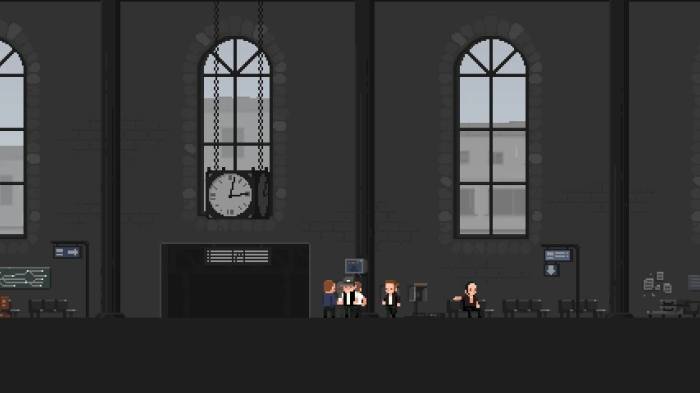
Then, the engineer will descend a level; he’ll find a passage leading underground, and one that inevitably loops back in the direction of his train. And in that passage, he finds the military taking prisoners, holding injured citizens at gunpoint, and, in one case, staring down an executed body.

This is core conceit of the game’s cyclical, sidescrolling levels—the engineer will traverse the land of a given station aboveground, maybe through a set of buildings or copse of houses. And at some point in that short journey, he’ll come across a grate he cannot open, and early in the game, the player might not think anything of it. But as it progresses and reveals itself more and more, that everpresent grate will be understood as exit to the passages and tunnels inevitably hidden beneath a level’s opening sequence: a network the player will always circle back into to return to their train, and usually the hiding place of that level’s blocker code. But rooms in this game only reveal themselves when entered, so at the start, those tunnels are invisible—part of a dark, slate-colored mass beneath a more natural opening space. It’s as if the player is walking over an anthill, unaware that this complex and convoluted warren exists beneath their shoes.

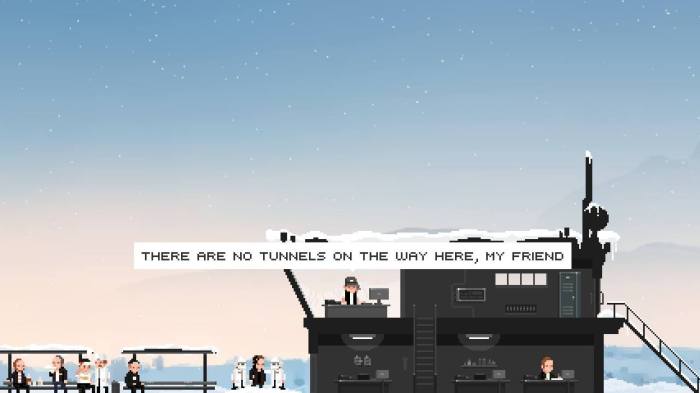
And over the course of the game, this conceit will be used again and again and again, sometimes with added flourishes or small tweaks to its simple formula. Every level is circular, just as the game itself is, with the end of each circle adding a final revelation. But one sequence especially stands out: around the halfway point, the engineer finds his train diverted to a series of dark, forsaken tunnels and stations that seem, from their forebidding architecture and surrounding darkness, almost like underground black sites. No one in the game will acknowledge these stations’ existence; the operator in the next city claims “there are no tunnels on the way here, my friend,” and other characters chide the engineer for his lateness. There should only have been two stops between the last city and this one—what took you so long? There are no secret bases privy only to the game’s military and corporate heads, no caverns filled with those thought-to-be alien capsules, suggesting a joint conspiracy to oppress the unnamed country’s populace. Oceania had always been at war with Eastasia. It’s the same thing—depth hidden by an illusory facade, revealed only by the player’s intrusion.
And in one of these black sites, as the engineer backtracks through the maze of rooms and corridors, he finds this kind of hidden revelation in much more literal form: he’ll emerge from a seemingly underground complex into a outdoor area where two moons can be seen, hanging among stars.

I stopped for a minute here and spent a moment taking that sight in. The game continued to surprise me after this point; somehow I continued to fall for its illusions and facades, but this was the one that gave me the most pause. This is a game (developed by a small Russian team) that depicts the disconnect between reality and perception, in particular the kind created in an Orwellian state. There’s a thread of totalitarianism here, both corporate and governmental, leveraging the truth to keep control over their subjects. The people who lived in these stations—all inevitably dead, their bodies never far from where the engineer finds the blocker code—went about normal, mundane lives, leaving chat windows on their computers and scrawled notes on their desks that the player can find and read. One went to chop some firewood; another had just been left by his wife. But we see their lives in the after—with them gone or transformed into the games dark, lumbering zombies. And structurally, all of this follows that same core theme: of facades, in space and in time, stumbled over, slowly stripped away.
The Final Station ends in congruence with its overall structure; the titular Final Station is in fact the first station—the engineer, who was offered a chance to stay in safety at the last city on his run, decides instead to venture back to his starting point. Like one of its levels, the game itself ends in a room just below where it begins, where it builds one last personal revelation into a story that unfolds with a kind of simple, elegant grace.
But before that, there was one other moment that made me pause and consider just how secretly aware this game was. After the train breaks down and the engineer heads out into the wilderness—a journey that will see him come to his own inevitable end—he finds a man in a clearing, covered in blood, with a briefcase by his side. Money is a presence in this game—mainly a way to buy weapon upgrades and ammo in those few populated stations, but after the last one, I’d wondered if money would stop appearing in the levels. I expected that, without a use for it anymore, the game might have decided to remove it.
Interacting with that man’s briefcase gives the engineer something like a million dollars. I’m not exaggerating (I didn’t count the exact number of zeroes, but they’re the length of a long text box), and this is far more than a player could ever use in the game’s small marketplaces. I’d assumed the game would just continue giving money because that was what it had done previously: that the developers might have just forgotten to stop giving me this now useless commodity in the final levels. Instead, with that tiny scene, they circled back to another the core truth of The Final Station: the world exists by itself, not to cater to your needs, but for you to move through on your way to the next destination. It is a progression and a cycle, underpinned by a vast conspiracy that you—an engineer on the last surviving train—are powerless to affect, much less to end.
And to cement that story in the player’s mind, the game repeats the same conceit level after level—an above and a below, an inside and an outside, a revealed world and a secret one hiding behind locked doors or beneath our feet. Over and over again it circles through these small slices of a larger world, its background—again, with its differed resolution—like a set to its foreground’s straightforward play. In every element of its design it embodies this motif of twisted reflections, of unknown spaces hidden in plain sight, and of the forces that conspire to keep them that way. In one fell swoop, The Final Station feels like both a callback to Orwell and Huxley, and a game wholly emblematic of our present moment: one that, at its ludonarrative core, depicts the illusions that perception and perspective (and the people manipulating them) can play on our understanding of reality and truth.

 Sunset Over Ithaca
One thought on “You Might Have Missed: The Final Station”