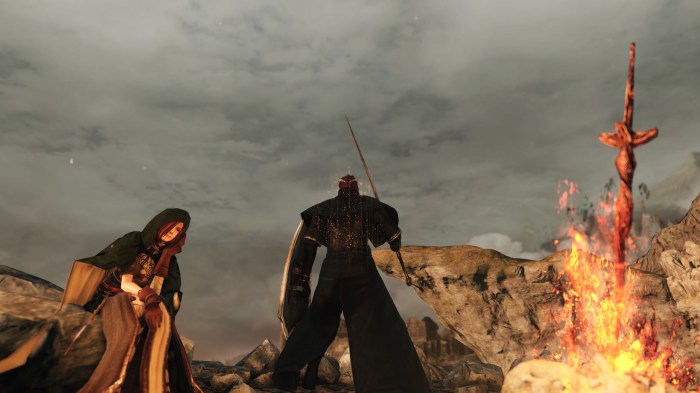
A few hours into Dark Souls II, I traipsed back to Majula from the Forest of Fallen Giants. Thus far, the second Souls game had greeted me with a dreamy, limbo-like tutorial level; a strangely peaceful hub town that, despite the subtle hints of death that drifted around its fringes, felt like Firelink Shrine without its overwhelming aura of depression; and a forest filled with ruins where hollowed soldiers hack mindlessly at the corpses of those they had fought in life. Up to that point, II had felt a lot like the first Dark Souls—they seemed to be sharing the same visual language of muted tones and morbid melancholia. And while the first Souls game had appreciably different areas—from the burnt umber of Lost Izalith to the muted royal blue of Ash Lake to the harsh, glowing balustrades of Anor Londo—they all seemed to come with the same filter. In each case, they seemed to follow naturally from one another, to share the same layer of grit and grime. In Lordran, space is cohesive. The world is an interlocking warren of passageways and elevators, all intricately and—most importantly, logically—connecting its component areas.
But then, those few hours into Dark Souls II, I rounded another corner and found myself somewhere entirely new.
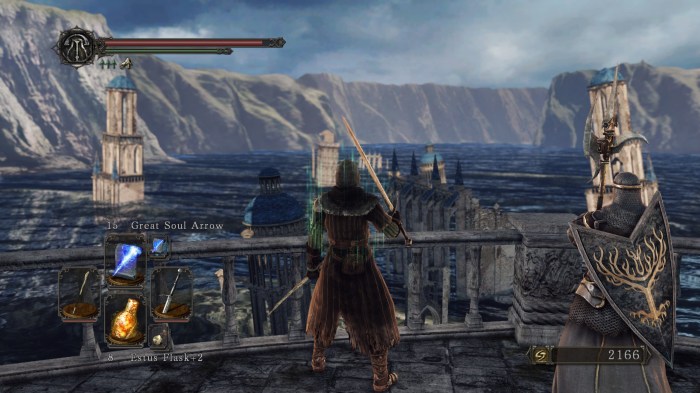
I had already felt like something was Different in Dark Souls II the moment I’d entered Majula, the aforementioned hub town. Anyone who has played an online Souls game is familiar with the sight of bloodstains on the ground—marks of where other players met their most recent demise—and the passageway to Majula from Things Betwixt has one spot, just before the end, where several always cover the ground. In Souls language, this means an enemy is around the corner, or a trap, or a drop that sent a cascade of players careening to their deaths.
But instead, you round the corner and are nearly blinded by the exit’s light. This happens every time, no matter the angle of approach. The game doesn’t want you to see what’s coming next—it wants you to step out, anticipating the threat it has already indicated is waiting around the bend, and wait for your eyes to adjust.
But when you do, there’s nothing by a gentle cliffside path leading down to some broken, keeling arches, and a spire on a cape overlooking the sea.
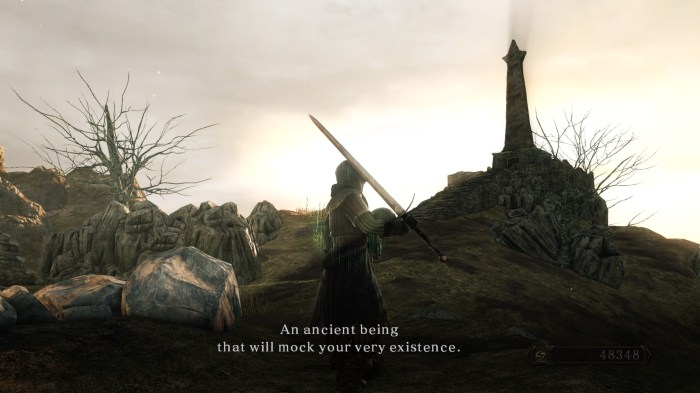
In a way, this is how Dark Souls II begins to reveal its hand. In Dark Souls I, every atom of Lordran seemed to operate on a simple goal: to kill you. The world was a body, its inhabitants its immune system, and you were a bacterial invader. They sought you out, relentless, focused, determined to end your quest as soon as it began.
But in Dark Souls II‘s Drangleic, some of the enemies barely seem to understand why they’re fighting you. They stumble or lumber along, aimless and fleeting, drawn to (still) try and murder you without really knowing why. The ragged white knights in Heide’s Tower of Flame don’t even rise when you first enter the area; they wait for you to slay the area’s first boss before even bothering to stand. The soldiers in Drangleic Castle begin as statues, shaking themselves to life as if awaking from a thousand-year slumber. They still fight, but everything seems tired. Exhausted, even. Like they don’t even know what they’re fighting for.
This is fitting, because it elucidates Dark Souls II‘s core thesis. At its heart, this is a game about loss.
***
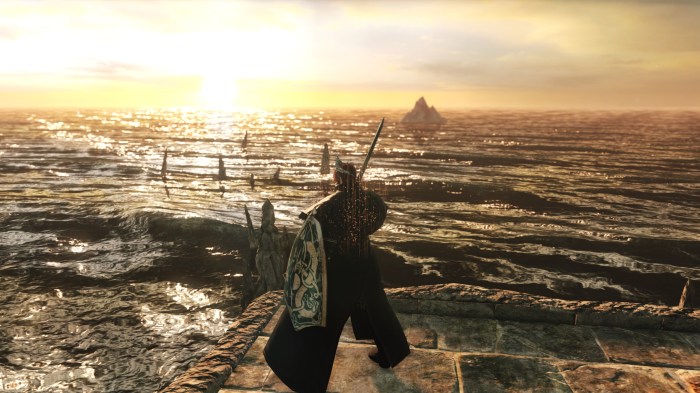
The passageway from the perpetually dawnlit ocean of Majula to the deep noontime sea of Heide’s Tower of Flame reveals one dimension of that loss. While Lordran’s pieces had interwoven into a clear and stable tapestry, Dark Souls II presents a world where space has lost its meaning. Over the course of its sixty-odd hours, the Bearer of the Curse will drift from those crumbling marble towers to a decaying, darkened wharf, from a warren of mossy, water-filled caverns to a sandy, spider-infested cove. They will pass from woods adrift with fog to a mountain pass saddled by a perpetual thunderstorm.
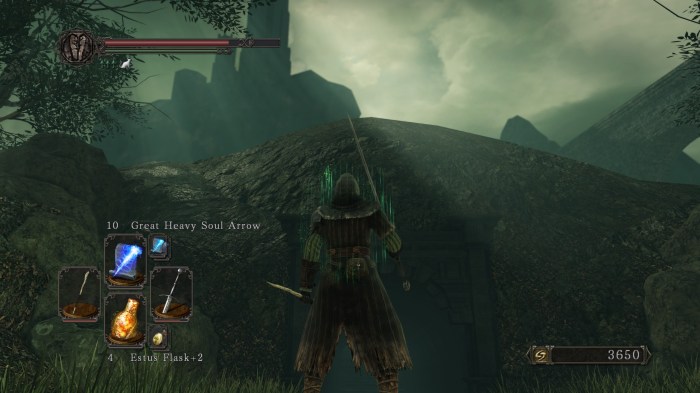

These two screenshots come in sequence; only a short tunnel separates the first from the second. Up that mountain path lies Drangleic Castle: those dark towers visible just above the cavern entrance. From a distance, they look dappled with sunlight. Up close, they’re overwhelmed by rain.
While Dark Souls I gave a cohesive world, where slices of its environs were visible from the edges and precipices of others, Dark Souls II breaks its world apart. This land is so adrift, so lost and fallen, that its very space has begun to distort. It’s fleeting, dreamlike, and entropic in a strangely literal sense.
You see, entropy reflects the increasing disorder of the universe—the idea that all energy must eventually languish in its least organized and, by consequence, least useful state. In our universe, that state is heat—all types of energy: chemical, kinetic, potential, light, will eventually be radiated by some kind of combustion (both the kind that takes place in engines and the kind that takes place within our own bodies) as heat. Eventually, once the universe reaches its “heat death,” nothing will remain but darkness, matter, and ever dwindling heat.
This comes alongside the idea of expansion, of a universe that grows and lenghtens like a balloon being blown up. Space itself isn’t expanding; the space between spaces is. A pair of points that were an inch apart one year might be an inch and an atom apart the following. Dark Souls II is the midpoint in that expansion—a space where its energy is nearly used up, and where its realms have drifted from each other’s sides.
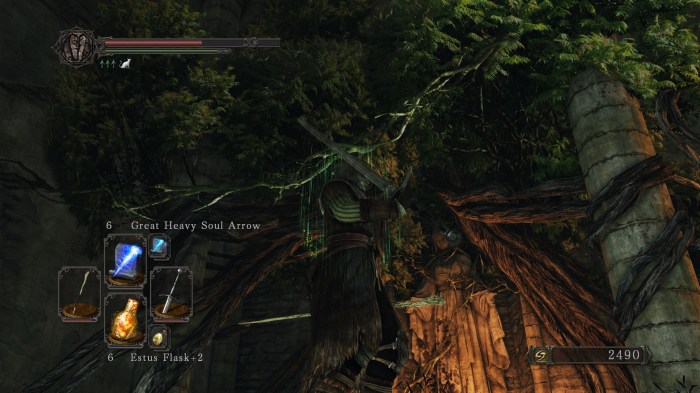
Yet at the same time, this comes with unexpected collision. In the Forest of Fallen Giants, a tree has grown into a ruin—its branches wrapped around pillars, its trunk one with the roof, sprouting leaves into the shadows. In this late stage of decay, the material and the organic have ceased to differentiate. This world has forgotten the difference.
This all combines to create something incredibly wistful—a world that embraces its ever-present sense of melancholy in a way entirely different than the first game’s atmosphere of depression and decay. While I came away feeling like Dark Souls I might have been set in Hell (and not just the part that actually is), Dark Souls II seems, almost assuredly, to take place in a sort of purgatory. Drangleic, this forgotten kingdom lost when its king made war with the giants, seems not to be where people choose to go, but where they find themselves one day, never quite sure how they got there.
Every NPC you bring back to Majula tells the same story—of having come to Drangleic in search of something. Yet, when pressed on how they got there, they can never quite say. This land is affected by the series’ recurrent Undead Curse—a MacGuffin in magic form that curses its inhabitants to not die, but to wither until they’ve lost their humanity: until they’ve given in to entropy and, as the games put it, become hollow. And over the course of Dark Souls II, many of its friendly characters feel that fate creeping upon them. They murmur about their memories fading, about their pasts disappearing into the mist. As recurring character and occasional partner Lucatiel of Mirrah says when you encounter her for the third time, “I’ve found my thoughts growing hazy. My memories are fading, oldest first. The curse is doing its work upon me. I am frightened… terribly so… if everything should fade… what will be left of me?”
The fourth time, she continues:
“Loss frightens me to no end. Loss of memory, loss of self.”
“I don’t want to die, I want to exist. I would sacrifice anything, anything at all for this.”
“Sometimes, I feel obsessed… with this insignificant thing called ‘self.’ But even so, I am compelled to preserve it. Am I wrong to feel so? Surely you’d do the same, in my shoes?”
“Maybe we’re all cursed… from the moment we’re born.”
And the fifth?
“How goes your journey? I know not what you seek in this faraway land, but I pray for your safety.”
“My name is Lucatiel. I beg of you, remember my name. For I may not myself…”
***
Dark Souls II is a game about loss, but not about overcoming it. Dark Souls II is a game about the inevitability of loss, and how little the world might care once we’re gone. And mechanically, it signals this in a particularly poignant way—by flipping one of its series’ most important traditions on its head.
The Soulsborne games are designed around repetition—around learning an level, its enemies, their patterns and placements, and knowing exactly how to deal with each of them as you attempt to progress. Over time, these areas become written into a kind of muscle memory, an mechanical script of motions and attacks and brief, careful retreats as each enemy is systematically dispatched. So imagine my surprise when, after dying for the umpteenth time to the stone knights in Heide’s Tower of Flame, I awakened at a bonfire to find one of them conspicuously absent.

Unlike Dark Souls 1 and Bloodborne, Dark Souls II‘s enemies are not infinite. Only the main character is. After a certain amount of deaths, each and every overworld enemy will disappear—its spot in the world absent, another victim to Drangleic’s creeping entropy. The player can use a Bonfire Ascetic to revive them—to resurrect that area’s enemies and make them all stronger—but eventually the same fate will befall them. The other Souls games gesture at the same kind of endlessness that afflicts all video games—there will always be more souls, more monsters, more life to lay to waste. Dark Souls II reminds you that no, energy is finite. Eventually, entropy wins out. Someday, this will all be empty.
This creates a strange sort of melancholy—walking through long-defeated areas with half their inhabitants simply wiped from the face of the world. Especially in those first moments approaching a familiar battleground, you may wonder whether you’ll be faced with the same creaking, tired combatant as always, or with the specter of their absence. Loss permeates every fiber of Drangleic and every moment of Dark Souls II—whether in the long-departed memories you explore in the game’s final stages or the simple act of returning to an old area and wondering, “was there ever actually something here?” It’s like remembering a dream after sunrise and a cup of coffee—trying to catch its trailing threads as the waking world spirits it away.
***
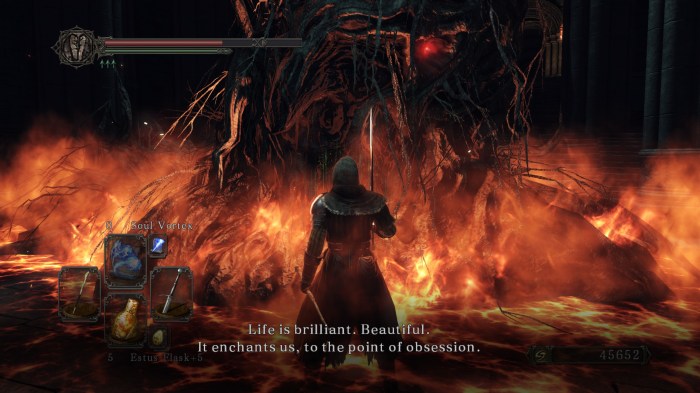
Dark Souls II is set in purgatory—that much is clear. From the remains of King Vendrick, tracing with his giant sword an eternal circle in the depths of the Undead Crypt, to the ashen mist in the memories of the slain giants, to the lost memories of those we meet along the way, we see the slow dissolution of order, the rise of entropic decay. This is where people go when they have nothing left—where they languish, for eons, as space and time lose all meaning. Heat, fittingly, remains a beacon—from the item text for the Homeward miracle: “The curse slowly erodes one’s memory, until even one’s birthplace is reduced to a figment of a clouded past. But the bonfires are constant, a beacon for the tragically afflicted.” Throughout Dark Souls II, fire is a waypoint, and a friend.
Dark Souls II presents flame, in all its aspects, as a method of holding on. It still holds the vestiges of a mostly-jettisoned mechanic—torches and braziers placed around the world, that, once lit, will remain lit for the remainder of that game cycle. Practically, this makes it easier to navigate the dark corners of The Gutter and No-man’s Wharf, and to scare the spiders away in Brightstone Cove Tseldora. More figuratively, it spreads the momentary calm of a bonfire, holding off the dark for a little while longer.
And fittingly, its final area is already lit with flame, and extinguishes in the aftermath of the series’ typical final choice. Beneath Drangleic Castle rests a massive, yawning cavern, with a winding stone path lit by torchlight. You pass its entrance about halfway through the game’s length—locked behind a door you cannot open, and that likely passes quickly from your mind. At that point, there is no indication of a chasm beneath your feet, of a greater threat lurking just out of sight. There’s no hint of this final area—this secret Throne of Want—that you’ll return to when the time comes.
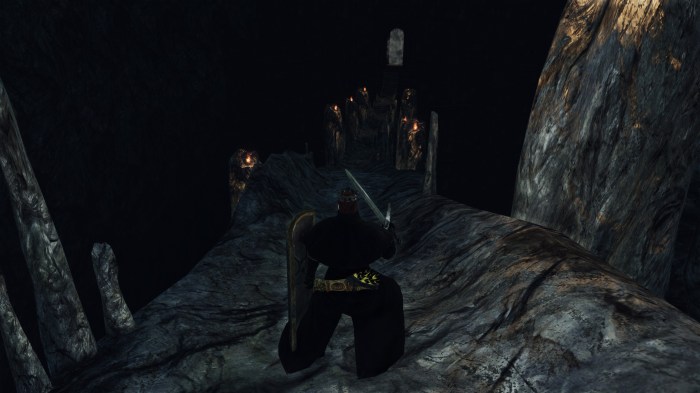
That is, of course, Dark Souls II‘s final gambit, the pairing of the series’ traditional power fantasy with a reminder of just how small you are in the face of its obstacles. And yet, Dark Souls II never embraces the same sense of scale that Dark Souls I showcased at every turn. It’s a much more intimate experience—and its thesis benefits from that. These spaces feel inhabited—they seem like places people might once have lived. In that, their absence feels stronger, more emphatic. It’s hard to tell who could have spent their days in Anor Londo—a city of the gods, seemingly built for giants. But from the houses in Majula to the cells in the Lost Bastille, Dark Souls II‘s spaces seem appropriately human-sized. And that makes their absence, and the resulting feeling of loss, seem much more real.
Because again, Dark Souls II is not a game about overcoming loss. Loss, as it presents, cannot be overcome. It can only be faced—come to terms with—and accepted for what it is.
Eventually, this all will fade. We will drift into the heat death of the universe none the wiser, conquests and accomplishments fading from memory like a polaroid shaken in reverse. There may be an after in Dark Souls II, but it’s already signaling its shape. Space is losing meaning. Time will follow. And then, all will be still. The fires will extinguish, and only smoke will remain.
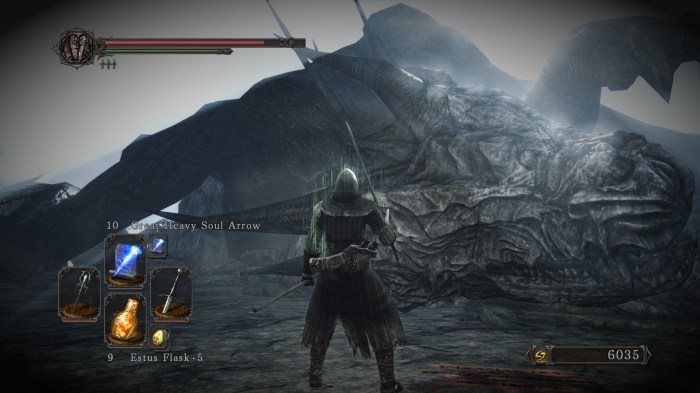
Should the Bearer of the Curse choose to reject the Throne of Want, Aldia, Scholar of the First Sin, will narrate the final cutscene.
“There is no path,” he says. “Beyond the scope of light, beyond the reach of Dark… what could possibly await us? And yet, we seek it, insatiably… such is our fate.”
In the end, there may well be no way out. No relief from the march of entropy or the inevitability of loss. It will all feel so fleeting. And yet, somehow, we had the chance to try, and that was worth every second.

 Sunset Over Ithaca
One thought on “On Dark Souls II: Ephemera, Entropy, and the Inevitability of Loss”