There’s a moment, at the start of Salt and Sanctuary’s ethereal final act, where everything makes sudden, horrible sense. Where, in the space of a single character’s brief, hesitant monologue, the game’s patchwork story is thrown into sharp relief. Until then, its pieces had drifted like the waves that wash the game’s main character ashore on its mysterious, desolate island. But in that instant, like a flame illuminating the nooks and crannies of a room that had seemed far smaller in darkness than in light, the game blows its scope wide-open.
[Warning: full spoilers ahead for Salt & Sanctuary, Ska Studios’ 2016 Soulslike-Metroidvania.]
Salt and Sanctuary begins with a voyage gone awry. A ship, ferrying a supposed princess to another land to complete a marriage treaty, is boarded and destroyed by a monster from the ocean’s depths. For most new players, this beast—The Unspeakable Deep—will likely kill them in one hit, and they’ll awaken on the shores of the game’s island setting with that grand, traditional goal in mind. Rescue the princess, and return home.
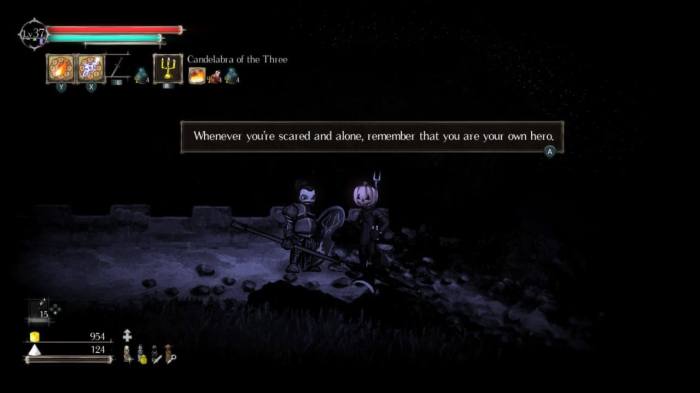
That’s the first of both Salt and Sanctuary‘s core misdirections and the narrative beats that set up its final revelations. The others are delivered by several NPCs the main character meets as they set out to explore this strange, piecemeal island—a masterless knight, a thief, and a sorcerer, to name a few. As you meet them in each subsequent location, teasing out their strands of dialogue with button presses that mirror their reluctance to voice their rising terror, their stories begin to form an intricate web. Each came from a different kingdom on a voyage; each was wrecked, their ship destroyed, and woke up castaway on the shores of this nameless isle. And as you explore its salt-filled environs—a castle wracked with never-ending storms and assailed by a rock-scaled dragon; a temple filled with the ghosts of those sacrificed in the name of a dead religion; a ziggurat where magicians had once practiced calamitous spells; a dungeon so filled with torture devices they’ve began to come alive in its halls—the game’s core world becomes clearer. This island is not its own space; it is a collection of cursed spaces agglomerated together—the remains of lost kingdoms and fallen religions fused together like a spectral, hellish landfill.
In that sense, Salt and Sanctuary drifts in the direction of a tighter Dark Souls II—a game about spaces losing meaning, about the decay that entropy brings to all civilizations. It shares the Soulsborne games’ critical focus on (and heavy distrust of) religion; yet, at the same time, it conscribes you at the start to your own core creed. And furthermore, it differentiates itself by placing a clear and malicious antagonist at its core; instead of the entropy and decay of the universe, it invokes the monstrosity and greed of a nameless god. The game’s first act is slow to the point of torturousness, but in those murky, greyish hours, it sets up the dominos—like the main character’s core devoutness—that collapse into that final, horrible image. The first key is directing most new players towards the worship of The Three; a religion based around a king, a knight, and a judge that’s a not-so-subtle stand-in for Christianity. That domino resolves when, deep in the Crypt of Dead Gods, the game’s penultimate area, you meet the skeletons that had once been those three deities and slaughter them for good. You’ve gone from believing in a god, to seeing them dead and decayed, to destroying them at the end of your journey. Their religion lasted long after they’d fallen from splendor.
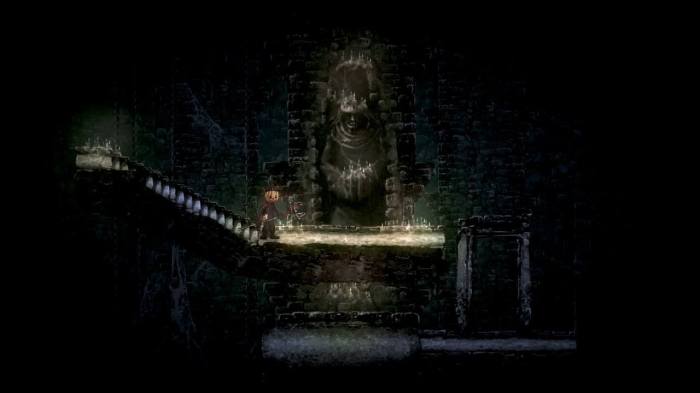
Like many other games in the Souls mold—especially Bloodborne and Hollow Knight—Salt and Sanctuary builds its final act around deicide. These games end their showdowns with corrupt religions (and would likely argue that there is no other kind) by allowing the player character to literally kill their gods (their own or someone else’s, or both). And in doing so, they grant those religions a kind of twisted legitimacy; those gods are real—they walk among us. But unlike many of the games’ NPCs often think, they do not mean us well.
Except Salt and Sanctuary twists that conceit just a bit further, and brings us back to that moment I mentioned at the start of this post. As you explore this island of misfit lands, slaying its collection of crazed priests and princes and abominations and beasts, you begin to hear whisperings of another god—a god, like that original Unspeakable Deep, that no character can name. As you meet them on your journey, those other NPCs begin to realize that their journeys did not end in unexpected wrecks; they were drawn here, on purpose, by something lurking deep beneath the island’s misty shores. All of these religions, decayed and decrepit, were captured by the gravity of something that lusted after their worshippers, their devout.

This is the final act of Salt and Sanctuary—a stretch of four or so hours that pay off on every whisper and sign and motif the game painstakingly builds. For much of its length, its title-screen of an upside-down tree seems obtuse, pointless, just a random attempt at edginess. But early on, the player gets their first Metroidvania-esque ability (conferred by branding, as if membership in a cult granted the ability to manipulate gravity and space), which allows them to trigger static obelisks around the world and, for a time, reverse gravity. Rightside-up and upside-down gain new meaning as surfaces, in some inverted, MC Escher non-illusion, become doubled. And then, in one late-game area, the water rivulets that had once trickled from platform to platform begin to flow upwards.
It all creates this mounting sense, especially in those final hours, of something horrifically wrong waiting just around the corner. Of some cosmic horror, some eldritch abomination—except, in an inversion of the genre’s typical conceit, this one cares all too much about you, and one that you can all too easily become.

See, that’s where Salt and Sanctuary finds its horror, and where it differentiates itself from the games it’s often accused of cloning. In Souls, and Bloodborne, and Hollow Knight, the malice of those games’ gods and monsters isn’t directed at you. The main character is always too small for their attention until the very end, just a fly wafting its wings around the face of a long-crumbling statue. But here? This god is your reflection. It engineered your coming, as it engineered so many others. That princess? It’s implied she was a slave forced in a grand conspiracy to guide your ship to this island of salt. To this place of dead kingdoms, sucked dry by a deity that envies worship, and the life that, in this game’s cosmology, that worship fosters. Instead, this god’s life comes from salt—the same salt that springs from every bag and body on the island. The same salt that imbues the main character with power, that blacksmiths work into their weapons and armor, that alchemists transmute into staves and swords. But this salt brings only punishment and pain. It seems, rather than life, to be a relic of life. Perhaps a relic of the ocean that had once covered this island’s shores—the residue left behind as its waves receded, capable only of a twisted facsimile of the real thing.
But, whether saltborn or candelit, no life in Salt and Sanctuary seems worth saving. More than Dark Souls, or Bloodborne, or Hollow Knight, it reminds me most of Silent Hill 2—of that game’s abominable reflections of its characters’ sexuality and greed. Of its twisted spaces and parallel universes pushing into each other, and its horrors peering around each corner. In the final area of Salt and Sanctuary, everything is upside-down. You now walk on the underside of stairways, catch the bottom edges of platforms. There is no color, no saturation; everything is shimmering black and white. And the music that had stayed uniform throughout the game gives way to a heavy, mournful organ. The islands’ horrors are finally apparent; The Nameless God is close at hand, and the distance that had kept you safe from its siren song is gone.
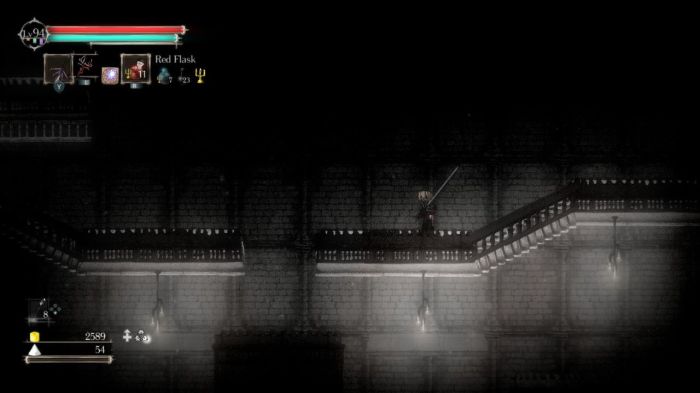
That final boss fight is easily the hardest in the game, and, of course, it fits perfectly. It’s the only boss fight in the game with its own unique music—and the only one that forces you to take fall damage when you land in the Nameless God’s arena. That animation places the character in a brief kneel—forced, here by the area’s architecture, to give a sign of worship. The organ swells, and the fight commences. The game’s terror, sourced from its unknown, becomes horror, laid in stark relief. This god may be nameless, but over the past few hours, you’ve come to learn everything else.
And, after the fight is over, you’re given a choice. Plunge down a bottomless well to salvation, or take the helm, and become the Nameless God yourself.
This game’s two closest comps—Souls and Silent Hill 2—both make their bones on complicating their medium’s inseparable relationship with power fantasies. In the former, they cast a journey from powerlessness to absolute power, and repeat it in an endless cycle that itself drives the universe to ruin. In the latter, they drive the game’s main character into a spiral of madness and deceit, torn apart by his trauma and vanished memories. Salt and Sanctuary meanwhile tempts its players with the idea of conquest and crusade; it pulls from Lovecraftian themes, but twists those from a xenophobic and racist allegory into one that instead others religious institutions, their soldiers, and their gods. And it puncuates their inclusion with an inversion—that eldritch being that the game sets you up to fear is your own twisted, warped reflection.

In doing so, Salt and Sanctuary builds one of the most rewarding final acts I’ve experienced in a video game, that translates an atmosphere of mounting dread into a sequence of sudden, heightened horror, and then, in its final moments, a rush of catharsis. Unlike some of the Souls and Silent Hill games, its endings are simple. They require few hoops or additional conditions—no long side quests or secret item caches. Instead, they give you a choice—seek salvation and find the catharsis of escape, or become the Nameless God yourself. Choose the former, and you’ll fall into the earth only to emerge on the surface of a bright blue ocean: an incredible visual after hours on the island’s desaturated wasteland . Choose the latter, and the upside-down hallways of the Still Palace will, in the course of one final camera-pan, become rightside-up.

The implication—the Nameless God chose its fate, just as you chose yours. That thing you feared, that through its envy and greed brought so many souls to ruin—you and it are not so different after all. If you choose to take it’s helm, the cycle begins again, unbroken. The horror is no longer the other, creeping around the edge of the frame.
Now, the horror is you.

 Sunset Over Ithaca