Imagine, for a moment, you’re a host in the midst of a group conversation with seven other people. Every few moments the focus shifts from person to person—each of them asking you a different question or opening up a new line of thought. Now, to really sum up the experience of playing The Get Out Kids—a mobile adventure game currently exclusive to Apple Arcade—imagine that, whenever a new person initiates a line of dialogue with you, they refer to you by a different name.
All of these names, to be clear, are yours. Or at least they should be. So the experience is, understandably, a bit disconcerting—requiring continuous adjustments to slide yourself into a new point of view while remaining, in all intents and purposes, the same exact person you were before.
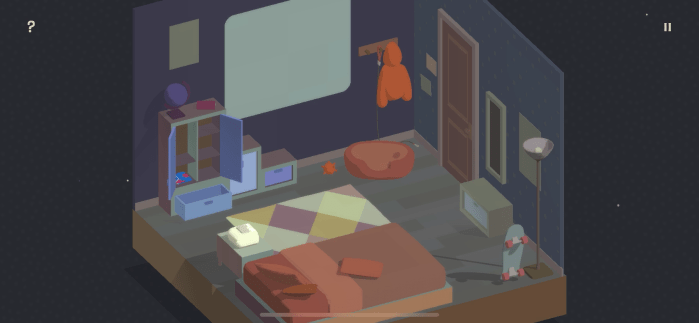
The Get Out Kids is not the first video game to play with perspective and point-of-view; after all, those concepts are irrevocably baked into the very idea of a video game. But it’s a fantastic example of what happens when those perspectives aren’t molded with proper care—those little shifts creating a tiny yet everpresent sense of alienation that prevents the narrative itself from ever fully clicking into place.
***
But first, let’s zoom out a bit and take a look at a larger idea. Point-of-view in games is an inherently multifacted concept; “you” are, in effect, in multiple places at once. You are there playing: sinking into your couch, or lying on your bed, or sitting in a bus or subway carriage on the way to work. And “you” are also, of course, there in the game as well—controlling a character, or being controlled by the game, or doing both at once. All games are, in a way, a second-person experience. But the point-of-view they lay out for the player-character might be first-person or third-person or, in something like XCOM: Enemy Unknown, an interwoven combination of both.
With that in mind, the key to effective point-of-view in games is consistent clarity—it can shift and move and change, but when doing so, that transition needs to be clear. Think Super Mario Odyssey, a game that’s constantly flipping back and forth between what are effectively different characters with diverging abilities and skillsets. Or even What Remains of Edith Finch—a game that, in many ways, The Get Out Kids feels primed to emulate. The shift in point-of-view in these games is demarcated by an animation, or a visual or auditory shift. There are beginnings and endings to those transitions, and you—the player—should ideally never lose sense of who, or what, you are. Even, in the latter, as you go from human to cat to owl to shark to tentacled monster of the deep—it’s never unclear just who you’re supposed to be. In that game, you’re acting out a dying dreams of a child.
In The Get Out Kids, the very idea of “you” is much muddier.
***
[Note: story spoilers for an hour-ish long mobile game follow. Proceed with appropriate caution.]
The setup for The Get Out Kids is simple—think Stephen King, or Spielberg, or Stranger Things. It sets two young, pre-teenage characters, Molly and Salim, as the protagonists of that particularly 1980s brand of spooky backyard horror. And over the course of about an hour of story and gameplay, they explore a world that drifts just a little too far away from our own for comfort.
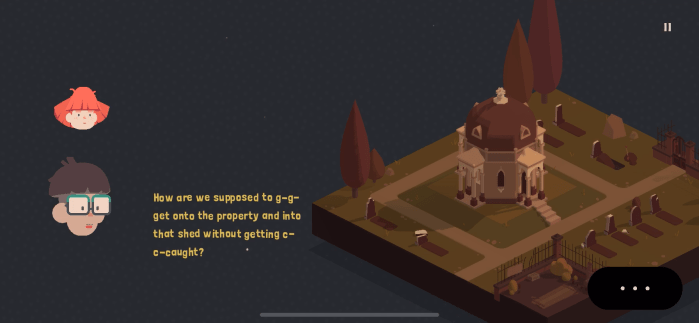
And there are moments where this works, where the atmosphere bleeds through and creates something that really does resemble those core texts to which this game is clearly paying homage. Its levels themselves are beautiful—these perfectly-constructed dioramas that look straight out of Monument Valley or Captain Toad: Treasure Tracker. That stuff—compartmentalized design and Gothic atmosphere—is catnip for me. But The Get Out Kids never allowed me to slip into anything resembling comfort or flow with its narrative, whether because it interrupted its story segments with unconnected gameplay sequences that feel, in the worst way, like make-work—or because, in those sequences, it could never quite decide who “I” was.
To put it more cleanly, in the world of The Get Out Kids, the player is everything and everyone—and by extension, nothing and no one. In any given moment or sequence, the game’s omnipresent tutorials might address me as one of its two protagonists, only to immediately swap its subject to the other a moment later. Or, in another sequence, it might place me as a character buying an item from a store, only to—for no real reason—have me calculate the change for that purchase as if I were the cashier. It might even occasionally ask me, when solving some of its notably Pokémon-ish puzzles, to control aspects of the world not tied to any particular character.
None of those things, on their own, are particularly novel for a video game. But when they’re all happening simultaneously and without warning, they create this gnawing feeling of dissociation. I was never comfortable playing The Get Out Kids, primarily because I never really knew who “I” was supposed to be. That can be a powerful tool or narrative device, but it never really felt like the game was trying to do this—just that it had never really thought to answer that question.
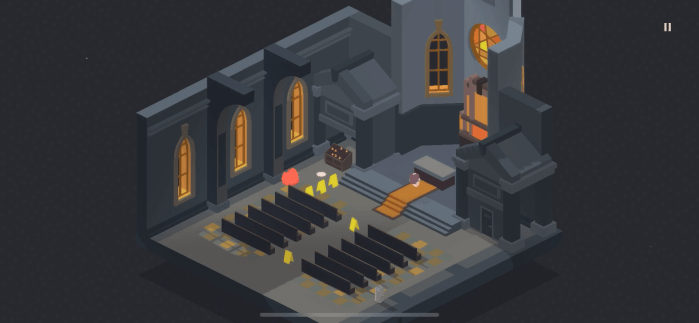
The Get Out Kids wraps up on a profoundly strange note—with death, near-death, and a couple of stunning revelations about a particular character’s history that should have had far more of an emotional payoff than they actually did. To conceptualize this using someone most of us will find familiar—Spider-Man—imagine if, after learning that some mystical supervillain had killed Uncle Ben, Peter Parker a) almost died at their hands, b) tried to kill them himself, c) assimilated their powers to avoid dying, and then d) moved in with them as his new surrogate family after e) Aunt May simultaneously died of a heart attack.
That is not hyperbole.

It all feels like The Get Out Kids intended itself to be a fairy tale. Or at least, it mashes a fairy tale ending onto the skeleton of Pennywise the Dancing Clown, without ever quite checking to make sure the two had fit together. It at once wants to be a grim, spooky horror story, a lonely fable about a pair of outcast kids, and a fairy tale about found family. But—in the same way it never quite commits to a clear point-of-view for its player—it never quite ends up being any of those things either.
Which is a shame, because the occasional pieces that do come through can be compelling. I could see this kind of dissociation working in a game’s favor, and not enough games actively toy with point-of-view in this kind of way. But here, it just feels like another in a series of incongruities—a suitable companion for a genre homage that just never manages to develop its own identity.

 Sunset Over Ithaca