[General content warning for gun violence, violence against pregnant women, incest, torture, and everything else. Also, I’m going to spoil Twelve Minutes, but you should probably consider that a blessing.]
In early 2020, a month or so before the start of the COVID-19 pandemic, I attended a local theatre festival about an hour from my hometown. A close friend of mine had written a script in college, and it was finally going to be on stage.
But, before we got to watch his play, we had to sit through the worst, most hackneyed and nonsensical stage production I’ve ever seen — a play that seemed intent on combining James Bond-style action with a screwball plotline about divorced and abusive parents with dialogue that crumbled apart every time an actor opened their mouth. Even by the standards of a small, local performance, the fact that those actors had rehearsed for weeks and weeks to put that play together felt like a travesty. After it ended, I remember saying that it felt like the product of a teenager who no one had had the courage to edit — and, as it turns out, it had been written by the 13 year-old child of one of the festival organizers.
Twelve Minutes does not have even that meager excuse. As far as I can tell, it was created by a team of adults. No nepotism magicked it into existence, or gave it a starring role in Annapurna’s 2021 lineup of games. It’s sheer existence is a mystery — or, at least, a web that wouldn’t be worth my (or anyone’s) time to delve into. Because, put simply, it’s the worst game I’ve ever played.
And here are twelve reasons why.
(1)
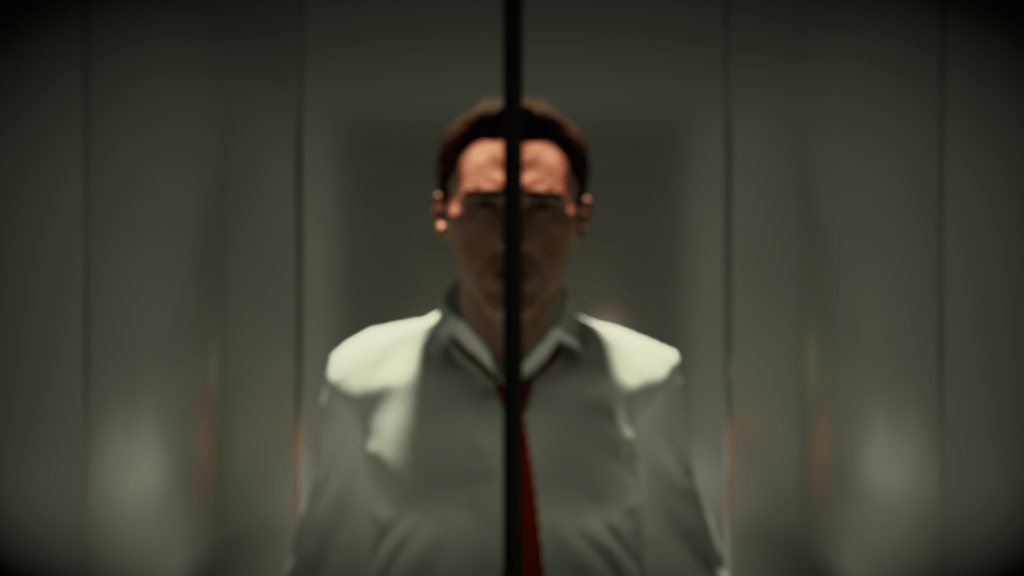
In the opening frame of Twelve Minutes, it’s already clear what kinds of art it’s aspiring to. The carpet in the hallway lifts its iconic pattern from Stanley Kubrick’s The Shining. Its cover art — of a red keyhole surrounded by echo lines — recalls the spidery frames and red-bathed silhouettes of various Hitchcock posters. That’s the company this game hopes to keep: it wants to be a thriller, a piece of horror fiction so cerebral and spellbinding it transcends the limits often saddled on the genre.
And yet its version of horror is driven by gore and gross-outs — by the promise of video game-y freedom coupled with a time loop’s lack of consequences. Want to watch your pregnant wife get kicked multiple times in the stomach? No? Well you need to to progress — through the slats in a closet door like a voyeur no less.
Think I’m being harsh? No, it’s quite literally shot like torture porn. The whole game is voyeuristic in a way that makes me incredibly uncomfortable — and while I think that it thinks it’s being voyeuristic in a Hitchcock-y, horror flick-y way, it just doesn’t, because it doesn’t seem to comprehend either the aesthetic sensibilities (namely camp) or the modicum of self-awareness that those elements need to give them depth. When that happens, the thing in question is usually either the bad writing of a teenage boy, or porn. It wants to be Vertigo but it ends up being The Room — a version of The Room that encourages you to knife or even shoot your pregnant wife because maybe, just maybe, it might be the solution to a puzzle.
(I could write an entire post entirely about the way this game treats violence towards women, but I don’t think its fascination with torturing its single female character deserves more airtime. It’s gross. It’s bad. It has no redeeming qualities. That’s all you need to know.)

(2)
But sadly, Twelve Minutes‘ attempts to gross its way to horror infamy don’t end there. Over the course of its few hours of tedious, repetitive gameplay (more on that later), you slowly learn that your character — the man supposedly voiced by James McAvoy — a) murdered his father, b) is the love-child of his wife’s father’s affair, and thus, c) is married to and sleeping with his sister. Delivered in a late twist long after you’ve probably figured it out and accompanied by a fair amount of wildly melodramatic groaning and screaming, the twist reveals that, over the past couple of hours, you’ve built empathy with and solved this mystery through a character who is — as the game repeatedly describes him — monstrous. It is again trying to be Hitchcock-y, to deliver a shock so mind-bending that it recontextualizes your entire experience with a piece of art.
Except, in this case, it recontextualizes nothing — it’s little more than the ‘gotcha’ at the end of a bad creepypasta, little more than Tommy Wiseau weeping and screaming in The Room‘s second most quoted scene. It’s not worth your time, or my time, or anyone’s time. Which brings me to—
(3)
Twelve Minutes, as a video game, fundamentally disrespects its players’ time. It’s not alone in this category, far from it, but the ways in which it forces reengagement with old dialogue and sequences for minute, circumstantial changes screams of padding. Playing with a guide, this game is maybe — maybe — an hour and a half long. Its average length on How Long to Beat? 4 and a half hours.
That’s not inherently bad — in truth, puzzle games should play much quicker with guides than blind. But that gap belies exactly what those extra hours involve: watching the same exact dialogue trees play out and shuffling through various items in this tiny, three-room apartment all while a time limit hangs over the player’s head. Miss one small element in its series of increasingly obtuse point-and-click puzzles and you’ll be sent back to the start with no recourse but to trace those motions again. There are no shortcuts, no breaks from its mind-numbing monotony. It’s almost as if its developers paid so much money for their all-star cast of voice actors that they want their players to listen to them utter the same banal phrase over and over and over and over and over and over and over and ov—
(4)
That cast by the way — James McAvoy, Daisy Ridley, and Willem Dafoe, heavily advertised in both the game’s opening credits and every piece of marketing material that came before — is utterly wasted on this pointless escapade. Not only is the dialogue hellishly bad, but the game’s voice direction is even worse. They deliver their lines with emotion, sure, but almost never with the proper tone and cadence for the scene. This, on one hand, evidences the challenge of constructing a dialogue system this complex — with endless conversational permutations, it would take a directorial masterstroke to have these disparate pieces line up. On the other, it reveals just how much more this team bit off than they could chew, and just how easily this game descends into unintended, oblivious camp. In moments a coversation might go from a genial hello to an accusation about a bygone murder — and then back to a quip about dessert, uneaten in the fridge. You know those memes — “I forced a bot to watch 1000 hours of Love is Blind and this is what it wrote” — well, Twelve Minutes is one of those for the works of Stephen King. The only difference is that it costs $25 dollars to play.
(5)
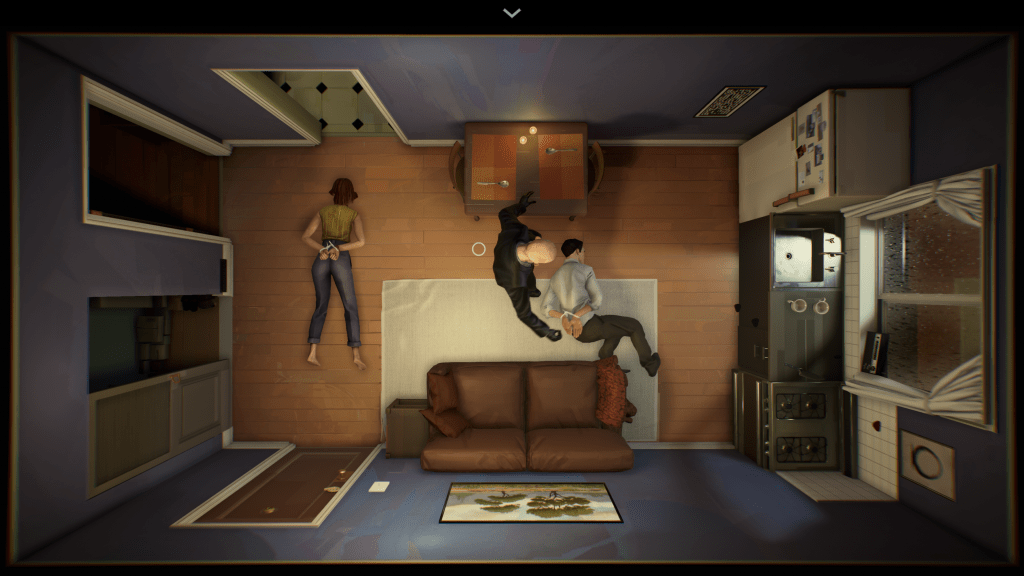
That dialogue, by the way? For a medium that sure contains some awful dialogue, it’s uniquely bad. This isn’t an absolute judgment; I’m sure you could find some knockoff Steam game somewhere with worse writing, but considering Twelve Minutes’ pedigree and the artists it’s attempting to channel, the sheer banality and pointlessness of much of its writing stands out as especially atrocious. Characters spout exposition at each other constantly — at least, when they’re not peppering the air with pointless umms and aahs. Dialogue is, as it turns out, the main container for Twelve Minutes‘ plot: a construct anyone who’s taken a single creative writing workshop should know is doomed to failure. The result is unnatural and stilted, a failure at both naturalism and entertaining kitsch. Moreover—
(6)
It dooms the game’s characters, rendering them empty shells of human beings. They have no consistent personalities, no traits or qualities that stick from loop to loop. They change constantly, doubly sympathetic and demonic with no space in between. They’re barely human — just empty statues for the writers to move around like dolls, impossible to truly empathize with because, functionally, they don’t exist. And the revelations fly so thick and fast that, the moment the game establishes something, even the smallest speck, about one of its cast of three, it immediately undercuts it with something even more hackneyed or ridiculous. This is the rare piece of published art that is so baldly inconsistent, it makes less sense when experienced for the second time.
(7)
But hey, it’s a video game! It’s a visual medium — there are other ways characters can interact. Maybe we can find something redemptive in there?
Nope.
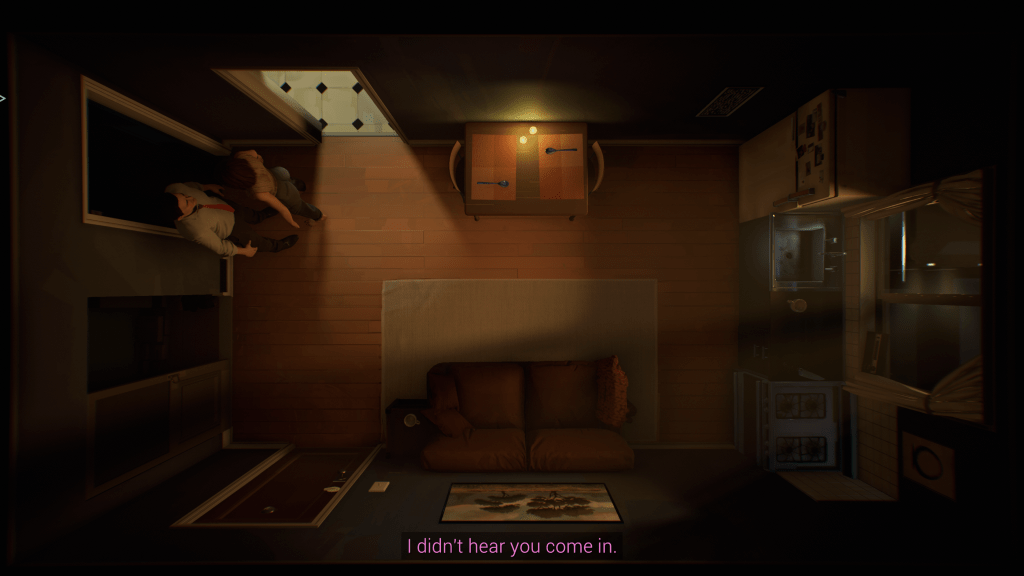
The only competent part of Twelve Minutes, it should be said, is its environmental art. The apartment, while not visually revelatory, is quite vivid and appealingly brought to life; it’s a shame then, that its characters are anything but. Their animations are wooden, zombielike, (And, apparently, were motion-captured? What the fuck??) Every loop the husband watches his wife emerge from the bathroom and come to him for a deep, passionate kiss, and every loop he tolerates her for a moment before, with a weak, milquetoast shrug, he pushes her away. Like much of Twelve Minutes, it’s almost comical — at least, it would be if the game seemed at all aware of its own campiness. Instead, it serves as a constant reminder of the game’s ineptitude, and its inability to produce or depict anything resembling real emotion.
(8)
Beyond those simple animations, Twelve Minutes also must solve a problem that comes with its unique top-down perspective. When climactic scenes play out — the cop cuffing the wife, the wife having her own breakdown — what should the husband look like? What can he do?
The answer, of course, is to stand there like a prop.
Games have, over the years, developed clever ways of wresting control from the player to maintain a sense of realism during climactic sequences (these are known, mostly, as cutscenes). Or, in the mode of Half-Life 2, they might allow players unlimited freedom over an interaction and play up its inherent campiness. Does Dr. Vance care when Gordon Freeman jumps on the table in the midst of a mission briefing? Nope — just another exploit in that endlessly weird scientist’s alien-slaying career.
Twelve Minutes, on the other hand, seems to just want to pretend that that problem doesn’t exist. A cop you’ve seen shoot your wife in the head in a previous loop breaks into your apartment and tackles her to the floor, and you stand there. Idling. Blinking. Waiting for the scene to play out, because of course you need another loop to solve this problem, and you’ve seen this before — you’re both already dead.
There’s something in there, buried deep inside, about the deindivituation that might come in the throes of a time loop. The kind of thing that Groundhog Day turns into the slow, excellently dire comedy of Bill Murray’s increasingly extreme suicide attempts. Here though? It’s just another weird, dissonant quirk of a game with exactly zero redeeming qualities. Carry on man. You’ll save her in the next one. Or you would if anyone fucking cared.

(9)
So how did it get this bad? How did a game like Twelve Minutes screw up the time loop — a conceit almost endemic to games as a medium, and that has led to several of the best games of the last few years?
Well, for one, it seems to misunderstand the basic structures that make time loops compelling. The tension in a time loop — whether a game, a movie, a book, or anything else — derives from the potential for change, the ability to shift the future, both personal and universal, by learning and repeating from the past. Time, when looped, becomes as malleable as space. Outer Wilds — a game that succeeds in everything that Twelve Minutes utterly fails to do — leverages that potential to tell a potent story about environmental cataclysm. 999, the first Zero Escape game and a precursor to games like 13 Sentinels and Paradise Killer, builds a compelling mystery with stakes and moments of genuine horror that are only made stronger by its infusions of humanism. Movies like Edge of Tomorrow and Source Code find in time loops a source of personal revelation — of growth and change that affirms that same kind of deep humanism. That people matter, emotions matter, that faith in one’s own abilities to change the world might not always be misplaced.
But Twelve Minutes wields this power with the surgical precision of a toddler with a hand grenade. Its characters don’t exist in any real, human way; the cop who routinely brutalizes your wife only stops when his daughter calls to tell him to listen to what you have to say… and that, in this work of staggering bullheadedness, is somehow supposed to humanize him. You, the husband — the incestuous murderous husband — stand around and watch this all play out until circumstances align just right, just right that you suddenly remember the past now coming back to bite. Calling it a cartoon sense of morality would do a vast disservice to most cartoons; calling it nihilistic would make Nietzsche roll over in his grave.

(10)
So Twelve Minutes is a cocky, boring, haphazard mess. But at least it’s a point-and-click adventure game — its control scheme should be simple, easy to implement, inoffensive at worst. As a premiere Game Pass game, it should be optimized well for the Xbox’s controls, shouldn’t it?
Oh, reader.
In a world where games like Into the Breach — with complex interfaces designed for point-and-click — can be played comfortably and easily on a controller, there’s no excuse for the constant stream of annoyances that is Twelve Minutes’ cursor. Everything in the game is point-and-click, and yet even on lowered sensitivity, the stick-directed cursor routinely slides and swings past the game’s sparse interactable objects and surfaces. A game aware of its own limitations might have invested in some kind of snapping feature, something that alleviates the aggravation of consistently missing the thing you intended to click on — again, with a time limit ticking overhead.
(11)
If I’m being honest here, this kind of reaction is almost unheard of for me. I tend to be overly positive on the media I interact with — even in things I don’t like, I’m drawn to those redemptive elements and moments, the pieces that something that got most things wrong just so managed to get right. But Twelve Minutes is such an egregious failure that I couldn’t muster up any of that positivity. It’s the only game on my Backlogged I’ve ranked below a 1.5 — on which, incidently, some 50% of my games are sitting at a 4 or 5. I took a criticism class in undergrad in which one assignment was a negative review; even then, the piece I wrote was lukewarm at worst because I couldn’t find a piece of media I really wanted to drag through the mud.
So thanks, Twelve Minutes, for finally breaking through those defenses. I can finally say I really, truly hate a video game. Which I’ll admit, should have probably happened a whole lot sooner than this. But here we are. Fuck.

(12)
There’s an old Stephen King quip from On Writing — a response (with a twist) to a question most professional writers are asked at some point, about the book that made them want to write. “Most writers can remember the first book he/she put down thinking: I can do better than this! Hell, I am doing better than this! What could be more encouraging to the struggling writer than to realize his/her work is unquestionably better than that of someone who actually got paid?”
I remember quite a few of these — some that I encountered as a kid, some that I’ve come across in the past few years. But rarely has this sense been quite as visceral as in the couple of hours I spent working through Twelve Minutes‘ proud, tempestuous mess. The fact that this game not only got made, but got a prime spot in Annapurna’s lineup and an all-star cast of voice actors should give every amateur and independent game designer faith. Or, just as likely, make them exceedingly mad.
That said, there is at least one small point in Twelve Minutes’ favor, and the only thing it holds over that play I saw almost two years ago: it’s on Game Pass.
So, hopefully, most of the people who play it will have played it for free.


 Sunset Over Ithaca
:format(webp):no_upscale()/cdn.vox-cdn.com/uploads/chorus_asset/file/22789930/Twelve_Minutes_walkthrough_1.jpg)
